Welcome!
The January 2022 Hunga Tonga-Hunga Ha’apai (HTHH) submarine volcanic eruption injected into the stratosphere an unprecedented 150Tg of water vapor– more than any other observed eruption. The HTHH eruption thus turned the theory of volcano-climate interactions on its head, prompting an international coalition of scientists to investigate the tropospheric, stratospheric, and mesospheric impacts of HTHH using numerical climate models and satellite observations. The final report for the HTHH Model Observation Comparision (HTHH-MOC) project can be found here.
Central to understanding the atmospheric impacts of the HTHH water vapor is an assessment of its residence time in the stratosphere. My research involves implementing a tagged volcanic water tracer in the National Center for Atmospheric Research (NCAR) Community Atmosphere Model (CAM), which enables precise tracking of the stratosphere-troposphere exchange and radiative impacts of the HTHH water vapor.
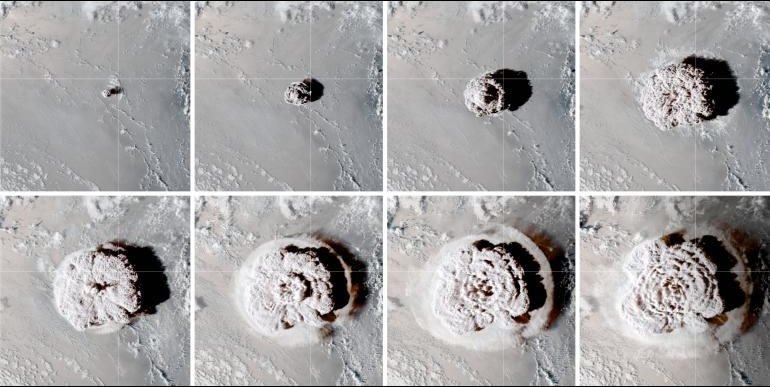
HTHH eruption captured by NASA's GOES-17 satellite (images courtesy of NOAA-NESDIS)