Research
Tagged volcanic water vapor tracer in CAM–removal pathways and radiative forcing
The explosive Hunga Tonga-Hunga Ha’apai (HTHH) volcanic eruption injected an unprecedented 150 Tg of water vapor into the stratosphere in January of 2022, leading to significant local cooling and ozone loss. Previous studies have determined the extent and impact of the volcanic water vapor plume using the difference between simulations with and without the HTHH water vapor perturbation. However, mixing with background water vapor and low signal-to-noise ratios limit the usefulness of this approach in precisely diagnosing the fate and radiative impacts of HTHH emissions.
In this project, I leverage the tagged-tracer capability of the isotope-enabled branch of NCAR’s Community Atmosphere Model version 6 (iCAM6) to develop a new tracer of volcanic water vapor. Atmospheric Model Intercomparison Project (AMIP)-style simulations of the volcanic water vapor tracer initialized according to the HTHH-Model Observation Comparison (HTHH-MOC) protocol clarify the relative importance of removal mechanisms like freeze-drying in the Antarctic polar vortex and cross tropopause mixing to the lifetime of HTHH water vapor. I also plan to diagnose the instantaneous radiative forcing associated with volcanic water vapor using a double radiation call in CAM. This work will provide a basis for similar studies of sulfate aerosols from HTHH or other volcanic eruptions.
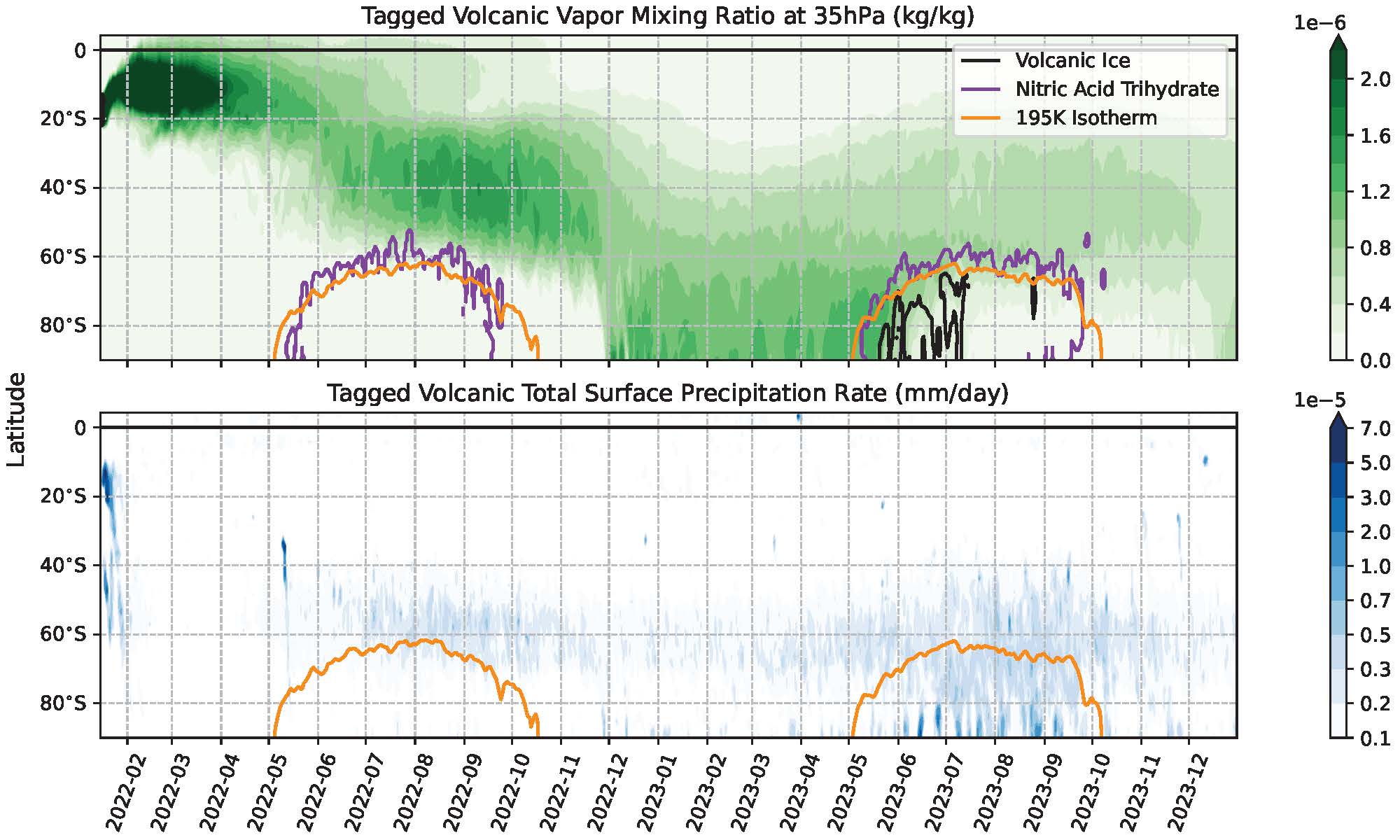
Modeled evolution of HTHH water vapor concentration (green contours) from 2022-2023 showing
enhanced surface volcanic precipitation (blue contours) in the polar vortex region.
Investigating QBO changes in a warmer climate using a simplified climate model
This project involves analyzing the Quasi-Biennial Oscillation (QBO) in idealized aquaplanet climate simulations. In an aquaplanet configuration of a full-complexity climate model, all terrain is replaced by a global ocean with prescribed sea surface temperatures and the seasonal cycle is removed. Aquaplanet models thus permit the simulation of key atmospheric dynamics processes without the complexity of atmosphere-surface interactions. I am investigating how aquaplanet stratospheric dynamics, such as the Brewer-Dobson circulation and the QBO, respond to increased carbon dioxide concentration and warming sea surface temperatures.
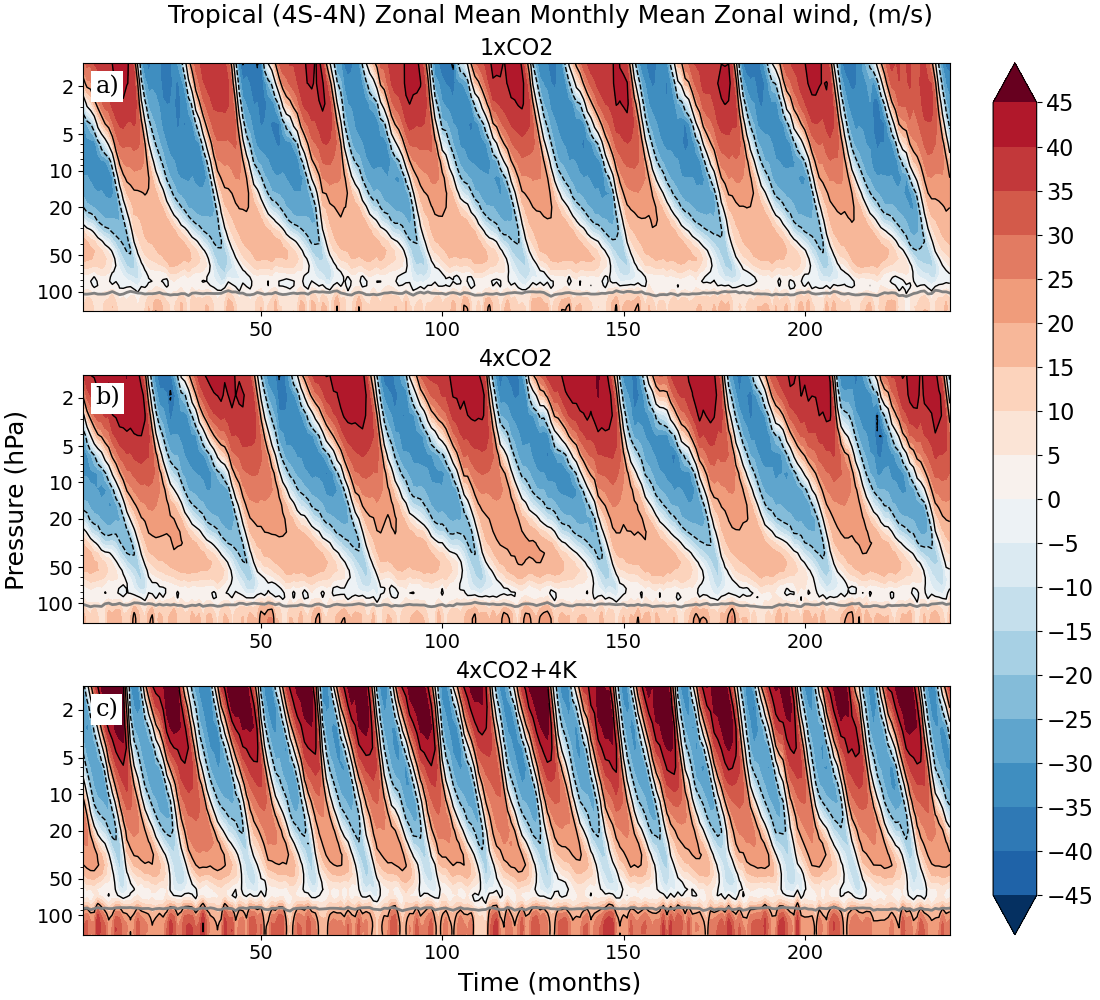
Timeseries of tropical zonal wind for three aquaplanet simulations: control CO2 concentrations,
4xCO2, and 4xCO2 plus 4K sea surface temperature warming.